
Best HVAC Diagnostic Tools for Technicians (2026 Professional Guide)
Published by HVACProSales Team on Mar 16th 2026
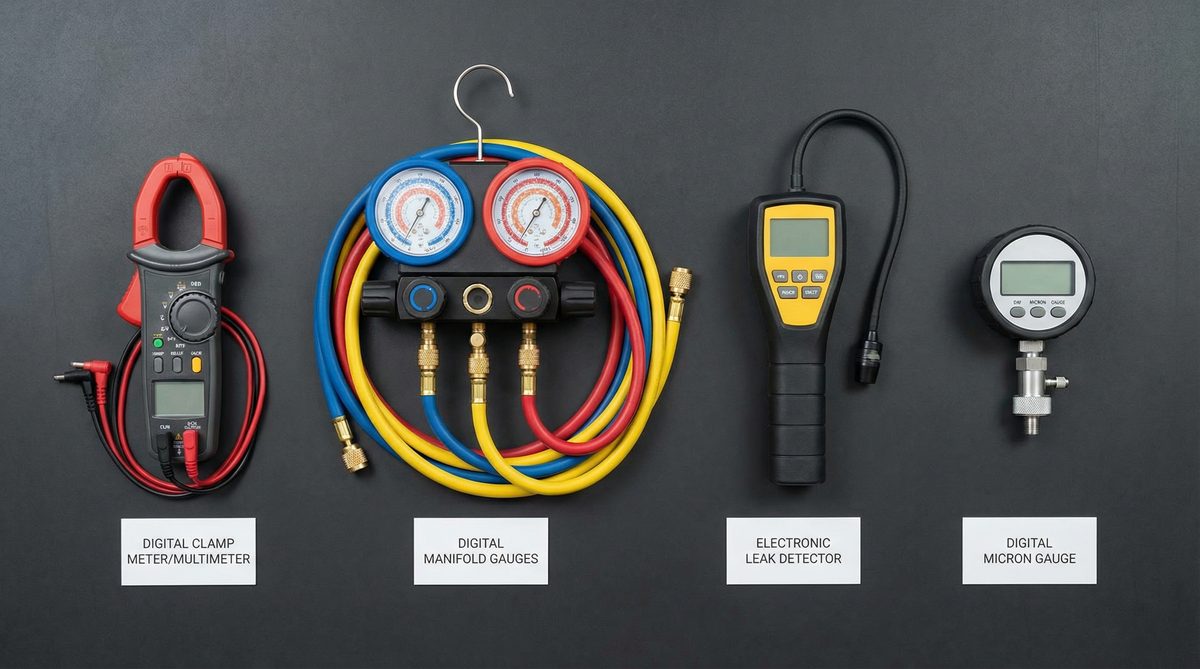
Best HVAC Diagnostic Tools for Technicians (2026 Professional Guide)
Quick Answer: What are the most important diagnostic tools for an HVAC technician?
The most critical diagnostic tools for an HVAC technician include a True RMS digital multimeter with capacitance and temperature functions, a reliable set of digital manifold gauges, a heated diode or infrared electronic refrigerant leak detector, and a standalone digital micron gauge. These tools are essential for accurately diagnosing electrical failures, measuring superheat/subcooling, and verifying deep vacuums.
Table of Contents
- The Importance of Professional Diagnostic Tools
- The Core Four: Must-Have Diagnostic Equipment
- Real Technician Scenario: The Ghost Leak
- Essential Hand Tools to Support Diagnostics
- Expert Summary: Key Takeaways for Technicians
- Frequently Asked Questions (FAQ)
The Importance of Professional Diagnostic Tools
For an HVAC technician, having the right tools is not just a matter of convenience—it’s a matter of professionalism, safety, and efficiency. Walking onto a job site with a well-stocked tool bag shows the customer that you are prepared to handle any problem you might encounter.
While the list of specialty hand tools can be endless, diagnostic equipment is where you make your money. Accurately diagnosing a failing capacitor, a restricted TXV, or a micro-leak separates the parts-changers from the true professionals. This guide breaks down the absolute must-have diagnostic tools for every HVAC professional operating in 2026.
The Core Four: Must-Have Diagnostic Equipment
If you are building your diagnostic kit or upgrading old analog equipment, these are the four pillars of modern HVAC troubleshooting.
1. True RMS Digital Multimeter (Clamp Meter)
Your multimeter is your first line of defense. Because 80% of HVAC failures are electrical, a high-quality meter is non-negotiable.
- Must-have features: True RMS (for accurate readings on variable speed motors), a clamp for measuring amp draw, a capacitance setting (for testing capacitors), and a K-type thermocouple input for temperature readings.
- Pro Tip: Always carry spare fuses for your meter.
2. Digital Manifold Gauges
While analog gauges are durable, digital manifolds have revolutionized the industry.
- Must-have features: Automatic superheat and subcooling calculations, built-in pressure-temperature (PT) charts for dozens of refrigerants, and wireless Bluetooth connectivity to smartphone apps for generating customer reports.
3. Electronic Refrigerant Leak Detector
Soap bubbles only work if you know exactly where to look. An electronic leak detector is essential for finding micro-leaks in evaporator coils and line sets.
- Technology choice: Infrared detectors are generally more accurate and have longer sensor life than heated diode models, though they come at a higher price point.
4. Standalone Digital Micron Gauge
You cannot accurately measure a vacuum with manifold gauges. A standalone micron gauge placed as far from the vacuum pump as possible is the only way to verify you have pulled a system below 500 microns and removed all non-condensables.
Upgrade your diagnostic capabilities today. We carry the industry's most trusted brands, providing the accuracy and durability you need in the field.
Real Technician Scenario: The Ghost Leak
A technician is dispatched to a home where the AC freezes up every three weeks. The previous technician simply topped off the R-410A and left, stating he couldn't find a leak with his soap bubbles.
Our technician arrives equipped with a high-end infrared leak detector. Instead of guessing, he isolates the evaporator coil and slowly sweeps the detector wand through the drain pan and along the U-bends. Within three minutes, the detector's alarm triggers rapidly near a rusted factory weld on the back side of the coil—a spot impossible to see or reach with soap bubbles.
The Result: The technician accurately diagnoses a failing evaporator coil, quotes a replacement, and solves the customer's recurring nightmare. The investment in a $400 leak detector paid for itself on a single service call.
Essential Hand Tools to Support Diagnostics
Even the best digital tools are useless if you can't access the equipment. A professional diagnostic bag must include:
- 11-in-1 Screwdriver: Indispensable for quickly removing access panels.
- Service Wrench: Specifically designed for opening and closing king valves on condensers.
- Wire Strippers & Crimpers: For repairing damaged low-voltage thermostat wires or replacing burnt spade connectors.
- Inspection Mirror & Flashlight: For reading faded data plates and inspecting the dark corners of heat exchangers.
| Tool Category | Must-Have Examples | Primary Function |
|---|---|---|
| Electrical Diagnostics | True RMS Clamp Meter, Voltage Pen | Testing capacitors, motors, and verifying power |
| Refrigeration Diagnostics | Digital Manifolds, Micron Gauge | Measuring pressures, superheat/subcooling, and vacuum |
| Leak Detection | Infrared Detector, UV Dye Kit | Pinpointing micro-leaks in coils and line sets |
| Airflow Diagnostics | Anemometer, Manometer | Measuring static pressure and CFM |
Tired of diagnosing leaky, inefficient ducted systems? Offer your customers the ultimate upgrade. Modern ductless mini-splits offer incredible efficiency and simplified diagnostics.
Expert Summary: Key Takeaways for Technicians
- Invest in Quality: Your tools are an investment in your career. Cheap meters provide inaccurate readings, which lead to misdiagnosis. High-quality tools last longer, perform better, and keep you safe.
- Go Digital for Refrigeration: If you are still calculating superheat in your head while balancing on a ladder, it's time to upgrade to digital manifolds. The time saved is worth the investment.
- Calibration is Critical: Even the best tools drift over time. Regularly test your thermometers in ice water and ensure your leak detector sensors are replaced according to the manufacturer's schedule.
- The Right Tool for the Right Job: Using pliers instead of a proper wrench rounds off bolts. Using the correct tool prevents damage to customer equipment and ensures a professional repair.
Frequently Asked Questions (FAQ)
Q: What is the single most important tool every HVAC tech should have?
A: If you could only have one diagnostic tool, it must be a high-quality True RMS HVAC multimeter with a clamp and capacitance setting. It is the key to diagnosing the vast majority of electrical problems, which account for the bulk of service calls.
Q: Should I buy my own tools or will my employer provide them?
A: Most HVAC companies expect technicians to provide their own hand tools and basic diagnostic equipment (like a multimeter and hand tools). The company will typically provide the larger, more expensive items like vacuum pumps, recovery machines, and sometimes digital manifolds.
Q: Are digital manifold gauges better than analog?
A: Yes, for diagnostics. Digital gauges are more precise, automatically calculate superheat and subcooling in real-time, and can handle multiple refrigerants without needing to swap hoses or read tiny PT charts. However, many techs still keep a set of analog gauges as a rugged backup.
Q: How often should I replace the sensor in my leak detector?
A: This depends on the technology. Heated diode sensors typically need replacement every 100-300 hours of use. Infrared sensors can last 1,000 hours or more. Always follow the manufacturer's recommendations to ensure accuracy.
Q: Why do I need a standalone micron gauge if my digital manifold has one built-in?
A: A standalone micron gauge placed directly on the system (as far from the vacuum pump as possible) provides a much more accurate reading of the deep vacuum inside the system. Built-in manifold sensors often read the vacuum of the hoses and the pump itself, giving a false sense of security.