

EER vs SEER vs SEER2: HVAC Efficiency Ratings Explained for 2026
Published by HVACProSales Team on Mar 26th 2026
EER vs SEER vs SEER2: HVAC Efficiency Ratings Explained
In the world of HVAC, efficiency isn't just a buzzword; it’s a direct link to your monthly utility bills and the long-term performance of your cooling system. As a homeowner or contractor, understanding the alphabet soup of efficiency ratings—EER, SEER, and the relatively new SEER2—is essential for making an informed investment. Since January 1, 2023, the Department of Energy (DOE) has implemented significant changes to how these ratings are calculated and reported, making it more important than ever to understand the nuances between them [1]. This guide will break down each metric, explain the shift to SEER2, and help you determine which rating matters most for your specific climate and cooling needs.
What is EER? Understanding Steady-State Efficiency
The Energy Efficiency Ratio (EER) is a measure of an air conditioner's cooling capacity relative to its power consumption at a specific, high-load operating point. Specifically, EER is calculated by dividing the cooling output (in BTUs) by the electrical power input (in watts) when the outdoor temperature is a steady 95°F, the indoor temperature is 80°F, and the humidity is 50% [2].
Unlike other metrics that account for seasonal fluctuations, EER provides a "snapshot" of how a unit performs during the hottest part of the day. This makes it a critical metric for residents in desert climates, such as Arizona or Nevada, where the air conditioner often runs at peak capacity for extended periods. A higher EER rating indicates that the unit is more efficient at cooling when it is under the most stress.
"EER represents the steady-state efficiency of an air conditioner, providing a clear picture of peak performance during high-demand periods." [3]
Alt text: A diagram showing the difference between EER's fixed 95°F test condition and SEER's variable seasonal temperature range.
What is SEER? The Seasonal Average
The Seasonal Energy Efficiency Ratio (SEER) was designed to provide a more comprehensive view of an air conditioner's efficiency over an entire cooling season. Instead of a single temperature point, SEER accounts for a range of outdoor temperatures (typically from 65°F to 104°F) to simulate how the unit will perform in the real world as the weather changes [4].
For most homeowners in moderate climates, SEER has historically been the primary metric used to compare different units. It reflects the average efficiency you can expect as your system cycles on and off throughout the spring, summer, and fall. However, as HVAC technology evolved and ductwork installations became more complex, the industry realized that the original SEER testing procedures didn't always reflect actual field conditions accurately.
The Shift to SEER2: Why the Change?
On January 1, 2023, the DOE introduced SEER2 (Seasonal Energy Efficiency Ratio 2) as the new industry standard. This wasn't just a rebranding; it involved a fundamental shift in the testing procedure, known as the M1 standard [5]. The primary difference lies in the external static pressure used during the testing process.
Under the old SEER testing (Appendix M), units were tested at an external static pressure of 0.1 inches of water column (in. w.c.). However, real-world ductwork typically creates much higher resistance. To address this, SEER2 testing (Appendix M1) increased the external static pressure to 0.5 in. w.c.—a five-fold increase that much more closely mimics the conditions found in a typical home installation [1].
Why SEER2 Ratings Look Lower
Because the SEER2 test is more rigorous and accounts for higher resistance, the resulting numerical values are lower than the original SEER ratings. On average, a SEER2 rating is approximately 4.7% lower than its SEER equivalent. For example, a unit that was previously rated at 14 SEER would be rated at approximately 13.4 SEER2 under the new standards [6]. It is important to note that the unit itself isn't less efficient; the testing method has simply become more accurate.
| Metric | Testing Standard | Static Pressure (in. w.c.) | Best Use Case |
|---|---|---|---|
| EER | Appendix M | 0.1 | Peak load performance in extreme heat. |
| SEER | Appendix M | 0.1 | Seasonal average in moderate climates (pre-2023). |
| SEER2 | Appendix M1 | 0.5 | Real-world seasonal average (post-2023). |
| EER2 | Appendix M1 | 0.5 | Real-world peak performance (post-2023). |
Regional Requirements and Compliance
The DOE has established different minimum efficiency standards based on three distinct regions in the United States: the North, the Southeast, and the Southwest. These regions have different climate profiles, and the regulations reflect the cooling demands of each area.
- Northern Region: The minimum requirement is 13.4 SEER2 (which is equivalent to the old 14 SEER standard).
- Southeastern Region: The minimum requirement is 14.3 SEER2 (equivalent to 15 SEER).
- Southwestern Region: Like the Southeast, the minimum is 14.3 SEER2. However, the Southwest also has specific EER2 requirements to ensure units can handle the extreme peak temperatures common in that region [1].
Alt text: A map of the United States divided into North, Southeast, and Southwest regions, highlighting the minimum SEER2 requirements for each.
How to Choose the Right Rating for Your Home
When selecting a new HVAC system, the "best" rating depends on your specific goals, your budget, and where you live. While higher SEER2 and EER2 ratings always mean lower energy bills, they also come with a higher upfront equipment cost.
Climate Considerations
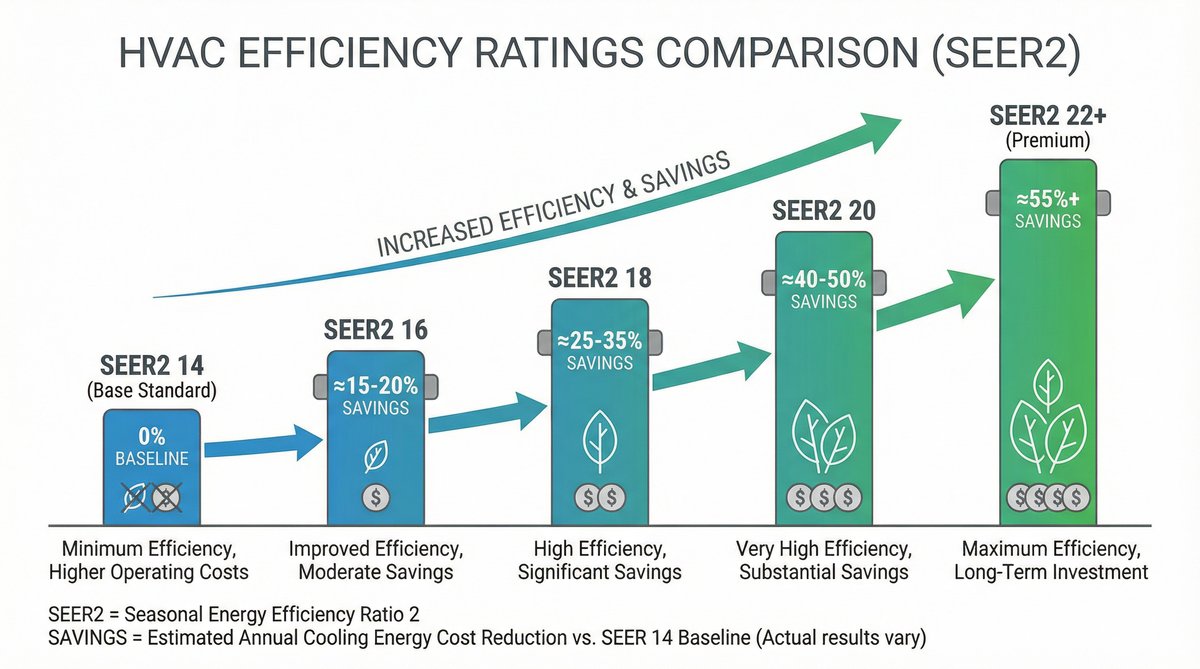
If you live in a climate with mild summers, a unit that meets the minimum SEER2 requirements may be the most cost-effective choice. However, if you live in the South or Southwest, upgrading to a high-efficiency unit (18+ SEER2) can result in significant long-term savings that eventually offset the higher initial price tag.
The Importance of Installation Quality
As an HVAC expert, I cannot stress this enough: a high SEER2 rating means nothing if the system is poorly installed. Because SEER2 accounts for static pressure, it highlights the importance of properly sized ductwork. If your ducts are too small or leaky, your high-efficiency unit will struggle to move air, forcing it to work harder and negating the energy savings you paid for.
Shop Central Air Conditioners | Shop Mini Splits | Shop Heat Pumps
Professional Checklist for Upgrading Your HVAC System
If you are considering a replacement, use this checklist to ensure you are getting the most out of the new SEER2 standards:
- Verify the Rating: Ensure the quote specifically mentions SEER2, not just SEER.
- Ductwork Inspection: Have a professional perform a static pressure test on your existing ductwork before choosing a unit.
- Regional Compliance: Double-check that the unit meets the minimum requirements for your specific state.
- Rebates and Incentives: Look for federal tax credits (like those under the Inflation Reduction Act) and local utility rebates for high-efficiency SEER2 equipment.
- Manual J Load Calculation: Ensure your contractor performs a proper load calculation to size the unit correctly for your home's square footage and insulation levels.
Frequently Asked Questions
Can I still buy SEER-rated units?
Since January 1, 2023, all new residential central air conditioners and heat pumps manufactured in the U.S. must be rated using the SEER2 standard. While some older SEER-rated inventory may still be available in the Northern region, the Southeast and Southwest have stricter "date of installation" rules that generally require SEER2-compliant equipment for all new installs [1].
Is SEER2 equipment more expensive?
Generally, yes. The new standards require more efficient components, such as ECM (Electronically Commutated Motor) blowers, to handle the higher static pressure requirements. While the upfront cost is higher, the increased efficiency typically leads to lower lifetime operating costs.
How do I find my unit's SEER2 rating?
You can find the rating on the EnergyGuide label attached to the unit or by looking up the model number in the AHRI Directory of Certified Product Performance.
What is a "good" SEER2 rating?
While the minimum is 13.4 or 14.3 depending on your region, "high-efficiency" units typically start at 16 SEER2 and can go up to 25+ SEER2 for advanced variable-speed systems and mini-splits.
Conclusion
The transition from SEER to SEER2 represents a major step forward in HVAC transparency and energy conservation. By accounting for real-world ductwork conditions, the new ratings give you a much more accurate picture of how a system will perform in your home. Whether you are prioritizing peak-load efficiency with EER2 or seasonal savings with SEER2, choosing a high-efficiency system is an investment in both comfort and sustainability.
If you have questions about which system is right for your home or need help navigating the new 2023 standards, our team of experts is here to help.
Contact HVAC Pro Sales Support:
? support@hvacprosales.com
? 1-866-330-1709