

HVAC Voltage Drop: How to Test and Fix Electrical Issues Guide
Published by HVACProSales Team on Mar 26th 2026
HVAC Voltage Drop: How to Test and Fix Electrical Issues
In the world of high-performance HVAC systems, voltage is the lifeblood that keeps motors turning and compressors cooling. However, even the most advanced equipment can fail if the electrical foundation is compromised. Voltage drop—the reduction in electrical potential as current flows through a circuit—is a silent killer of HVAC components. It leads to overheating, reduced efficiency, and premature motor failure. For professional technicians, mastering the HVAC voltage drop test is not just a diagnostic skill; it is a critical step in ensuring system longevity and safety.
What is HVAC Voltage Drop?
Voltage drop occurs due to the natural resistance within electrical conductors and connections. According to Ohm's Law ($V = I \times R$), as current ($I$) or resistance ($R$) increases, the voltage ($V$) consumed by the wiring itself increases, leaving less voltage available for the load (the HVAC unit). While some voltage drop is inevitable, excessive drop indicates a problem that must be addressed.
The National Electrical Code (NEC) provides specific recommendations for maintaining electrical integrity. While these are often found in informational notes rather than mandatory code requirements, they serve as the industry standard for professional installations.
| Circuit Type | Recommended Max Voltage Drop |
|---|---|
| Branch Circuit | 3% |
| Feeder + Branch Circuit (Total) | 5% |
For a standard 240V condenser, a 5% drop means the unit should receive at least 228V while under full load. Anything less suggests that the electrical infrastructure is consuming too much power, often manifesting as heat in the wiring or connections [1].
"Don't install anything in a way that's going to result in it getting hotter than it's supposed to get." — Bryan Orr, HVAC School [1].
Common Causes of Excessive Voltage Drop
Identifying the root cause of a voltage drop requires a systematic approach. Most issues stem from one of four primary factors:
- Undersized Conductors: Using wire that is too small for the Minimum Circuit Ampacity (MCA) of the equipment increases resistance. This is particularly common in older homes where a new, higher-capacity system was installed using existing wiring.
- Poor Connections and Terminations: Loose lugs, corroded wire nuts, or improper splices create "hot spots" of high resistance. These connections can fail spectacularly, leading to arcing or fire.
- Long Wire Runs: As the distance from the main panel to the equipment increases, so does the total resistance of the wire. For long runs, technicians must often "upsize" the conductor to compensate for this distance.
- Excessive Load Current: If the HVAC unit itself is malfunctioning (e.g., a failing compressor or seized motor), it may draw more current than designed, which naturally increases the voltage drop across the supply lines.
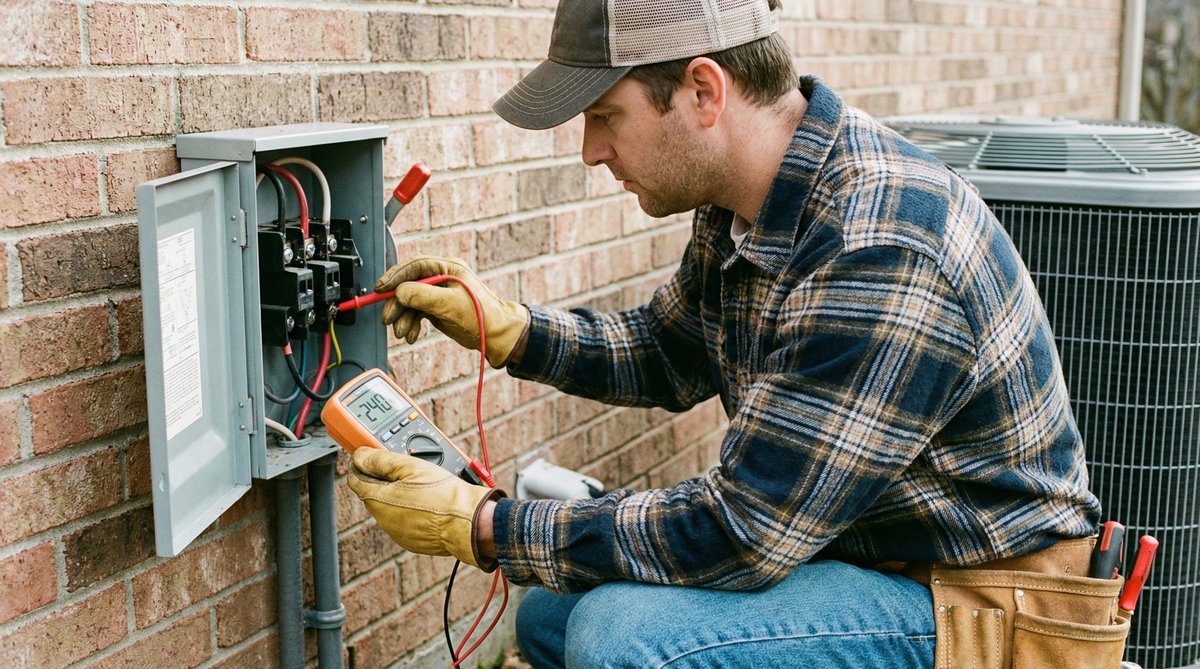
Alt text: A professional technician using a digital multimeter to test voltage at an outdoor HVAC condenser contactor.

Step-by-Step: How to Perform an HVAC Voltage Drop Test
The most important rule of voltage drop testing is that it must be performed under load. Measuring voltage at an open circuit (when the unit is off) will almost always show the full potential, masking any resistance issues that appear only when current is flowing.
Step 1: Measure Source Voltage
Start at the main electrical panel or the disconnect switch. With the unit off, measure the voltage between the two hot legs (for 240V) or between hot and neutral (for 120V). This is your baseline source voltage.
Step 2: Measure Load Voltage
Turn the HVAC system on and wait for the compressor and fans to reach full operating speed. Measure the voltage at the equipment's terminal block or contactor.
Step 3: Calculate the Drop
Subtract the load voltage from the source voltage.
* Formula: $Source Voltage - Load Voltage = Voltage Drop$
* Percentage: $(Voltage Drop / Source Voltage) \times 100 = \% Drop$
Step 4: Isolate the Problem
If the drop exceeds 5%, you must find where the loss is occurring. You can measure the voltage drop across specific segments of the circuit—such as across the disconnect switch or a specific length of wire—by placing one lead on the incoming side and the other on the outgoing side of the component while under load. A reading higher than 0.5V across a single connection or switch usually indicates a poor contact [2].
Pro Insights: Troubleshooting Electrical Issues
Experienced technicians know that a voltage drop isn't just a number; it's a symptom. If you find a high drop, use this checklist to narrow down the fix:
- Check the Lugs: Ensure all lugs in the panel and disconnect are torqued to the manufacturer's specifications. Aluminum wiring is particularly prone to "cold flow," where it expands and contracts, eventually loosening the connection.
- Inspect for Heat: Use an infrared thermometer or thermal imager to look for "hot spots" at breakers and contactors. A connection that is significantly warmer than the surrounding wire is a definitive sign of high resistance.
- Verify Wire Gauge: Check the MCA on the unit's data plate and cross-reference it with the wire size. Remember that NEC Table 310.15(B)(16) is the go-to resource for copper conductor ampacity [1].
- Don't Ignore the Ground: A voltage drop on the ground or neutral side can be just as damaging, especially for sensitive electronic control boards and communicating systems.
Shop Electrical Supplies | Browse Multimeters
Real-World Use Case: The "Ghost" Compressor Failure
A technician was called to a residential site where a three-year-old compressor had failed. The replacement compressor also struggled to start, frequently tripping the breaker on startup. While the static voltage was a healthy 242V, a voltage drop test during the startup inrush revealed the voltage plummeted to 185V.
The culprit? A previous installer had used 12 AWG wire for a 50-foot run to a 3-ton unit requiring a 30A circuit. The undersized wire couldn't handle the inrush current, causing a massive voltage drop that "starved" the compressor of the torque needed to start, eventually burning out the windings. Replacing the run with 10 AWG copper solved the issue permanently.
Call to Action
Don't let electrical issues compromise your HVAC installations. Ensure every system is running at peak efficiency with the right tools and components. For expert advice or to source high-quality electrical parts, contact our team today.
- Email: support@hvacprosales.com
- Phone: 1-866-330-1709
- Shop Now: Visit HVAC Pro Sales
FAQ
1. What is the maximum allowable voltage drop for an HVAC system?
The industry standard, based on NEC recommendations, is a maximum of 5% total drop from the service panel to the equipment. For a 240V system, this is a 12V drop (228V minimum).
2. Why does my voltage look fine when the AC is off?
Voltage drop only occurs when current is flowing through a resistance. Without a load (the AC running), there is no current flow, so no voltage is "dropped" across the wiring, even if the wiring is faulty.
3. Can a voltage drop damage my compressor?
Yes. Low voltage causes motors to draw higher amperage to compensate, which generates excessive heat. This heat breaks down the motor winding insulation, leading to a "short to ground" and compressor failure.
4. How do I fix a voltage drop caused by a long wire run?
The most effective solution is to increase the wire gauge (e.g., moving from 12 AWG to 10 AWG). Larger wires have lower resistance per foot, which reduces the total voltage drop over the distance.
5. Is a 2% voltage drop acceptable?
Yes, a 2% drop is excellent and well within the recommended limits for both branch and feeder circuits, ensuring your equipment operates at maximum efficiency.
References
[1] What Causes Voltage Drop and How to Deal With It - HVAC School
[2] Voltage Drop Test: Key Concepts & How To Do It - UTI