

How HVAC Inverter Technology Works: A Professional Technical Guide
Published by HVACProSales Team on Mar 26th 2026
How HVAC Inverter Technology Works: A Pro Explanation
In the world of modern heating, ventilation, and air conditioning (HVAC), the term inverter technology has become a cornerstone of high-efficiency climate control. For homeowners and contractors alike, understanding how this technology operates is essential for making informed decisions about comfort, longevity, and energy savings. Unlike traditional single-speed systems that operate on a binary "on or off" basis, inverter-driven systems utilize sophisticated power electronics to modulate performance with surgical precision.
The Core Concept: Fixed Speed vs. Inverter Technology
To appreciate the brilliance of inverter technology, one must first understand the limitations of the traditional alternative. Standard HVAC systems use single-stage compressors that run at 100% capacity whenever they are active. When the thermostat reaches the set temperature, the system shuts off completely. When the temperature drifts, it kicks back on at full power. This cycle, known as "short cycling," is inefficient and creates significant wear and tear on components [1].
In contrast, an inverter system is designed to vary its speed. Rather than stopping and starting, the compressor speeds up or slows down in small increments to match the exact cooling or heating load of the space. This continuous operation eliminates the massive energy spikes associated with motor startups and maintains a much tighter temperature tolerance within the home [2].
| Feature | Traditional (Fixed Speed) | Inverter (Variable Speed) |
|---|---|---|
| Operation | On/Off (Binary) | Modulating (Variable) |
| Energy Consumption | High (due to frequent startups) | Low (optimized for load) |
| Temperature Control | Fluctuates (±3-5°F) | Precise (±0.5-1°F) |
| Sound Levels | Loud (start/stop noise) | Quiet (continuous low-speed) |
| Component Lifespan | Shorter (high stress) | Longer (reduced cycling) |
The Technical Breakdown: How the Magic Happens
The "inverter" in an HVAC system refers to the electrical component that converts power to control the compressor motor's speed. This process involves several critical stages of electrical transformation.
1. AC to DC Conversion (The Rectifier)
The process begins with standard alternating current (AC) power from your electrical panel entering the outdoor unit. The first stop is the bridge rectifier. This component forces the AC current to flow in a single direction, effectively converting it into direct current (DC) [3]. This conversion is the foundation for all subsequent control, as DC power is much easier to manipulate than the oscillating AC wave.
2. Voltage Boosting and Smoothing (The DC Bus)
Once converted to DC, the power passes through a series of high-capacity capacitors on the inverter board. These capacitors act as a reservoir, smoothing out any ripples in the current and boosting the voltage. In a typical 230V system, this "DC Bus" can reach upwards of 300V to 340V DC [3]. This high-voltage DC is what provides the raw energy needed for the compressor's variable operations.
3. DC to Variable AC (The IGBT Switches)
The most sophisticated part of the process involves Insulated-Gate Bipolar Transistors (IGBTs). These are ultra-fast electronic switches that can turn on and off thousands of times per second. By precisely timing these pulses, the IGBTs "chop" the DC power back into a three-phase AC signal. However, unlike the fixed 60Hz frequency from the grid, this new signal can be delivered at any frequency the system requires—from 10Hz to over 100Hz [3] [4].
"The speed at which this switching process happens determines the frequency, measured in Hertz. This frequency control is what does an inverter do to precisely control the speed at which the compressor runs, making it truly variable speed rather than simply on or off." — GREE Comfort Technical Guide [3]
4. Motor Control and Sine Wave Simulation
By varying the frequency and voltage of the power delivered to the compressor motor, the system can simulate a smooth sine wave. This allows the motor to spin at exactly the speed needed to maintain the desired temperature. If the room is only one degree away from the setpoint, the compressor might run at 20% capacity. If the door is left open on a hot day, it will ramp up to 100% or even "overdrive" momentarily to recover [5].
Alt text: A technical diagram showing the flow of electricity through an HVAC inverter system from AC input to variable speed compressor control.
Real-World Benefits: Why Pros Recommend Inverters
As a professional HVAC technician, I often explain to clients that an inverter system is like driving a car with cruise control, whereas a traditional system is like floor-it-or-brake driving.
- Extreme Energy Efficiency: Because the system spends most of its time running at low speeds, it consumes significantly less power. Inverter systems often achieve SEER2 ratings of 20 or higher, compared to the 14-15 SEER2 standard for fixed-speed units [2].
- Superior Dehumidification: Long, slow run cycles are the secret to a dry home. Inverter systems run longer at lower speeds, allowing the evaporator coil to pull more moisture out of the air than a unit that shuts off quickly.
- Whisper-Quiet Operation: The loudest part of an AC unit is usually the startup. Since inverters ramp up slowly and often run at low RPMs, they are much quieter than traditional units.
- Longevity: Inverter compressors experience fewer "locked rotor" starts, which is the most stressful event for a motor. This reduced mechanical stress often leads to a longer lifespan for the most expensive part of your system.
Comparison: Inverter vs. Non-Inverter Heat Pumps
When it comes to heat pumps, inverter technology is a game-changer for cold-climate performance. Traditional heat pumps lose capacity rapidly as the outdoor temperature drops. Inverter-driven "Hyper-Heat" or "Ultra" systems can maintain 100% heating capacity even when temperatures fall well below 0°F by ramping up the compressor frequency to compensate for the lower refrigerant density [3] [6].
Pro Insights: Installation and Maintenance
While inverter technology is superior, it requires a higher level of expertise for installation and service.
* Communication is Key: Inverter systems use "communicating" thermostats and boards. Unlike a simple 24V signal, these components exchange data packets. Using the wrong wire or poor connections can lead to mysterious communication errors.
* Clean Power: Because inverter boards are sensitive electronics, we always recommend high-quality surge protectors. A power spike that might only trip a breaker on an old unit can fry a $600 inverter board.
* Proper Charging: These systems are incredibly sensitive to refrigerant levels. Using a scale to weigh in the charge is non-negotiable for inverter systems; you cannot simply "slug it in" by feel or sight glass.
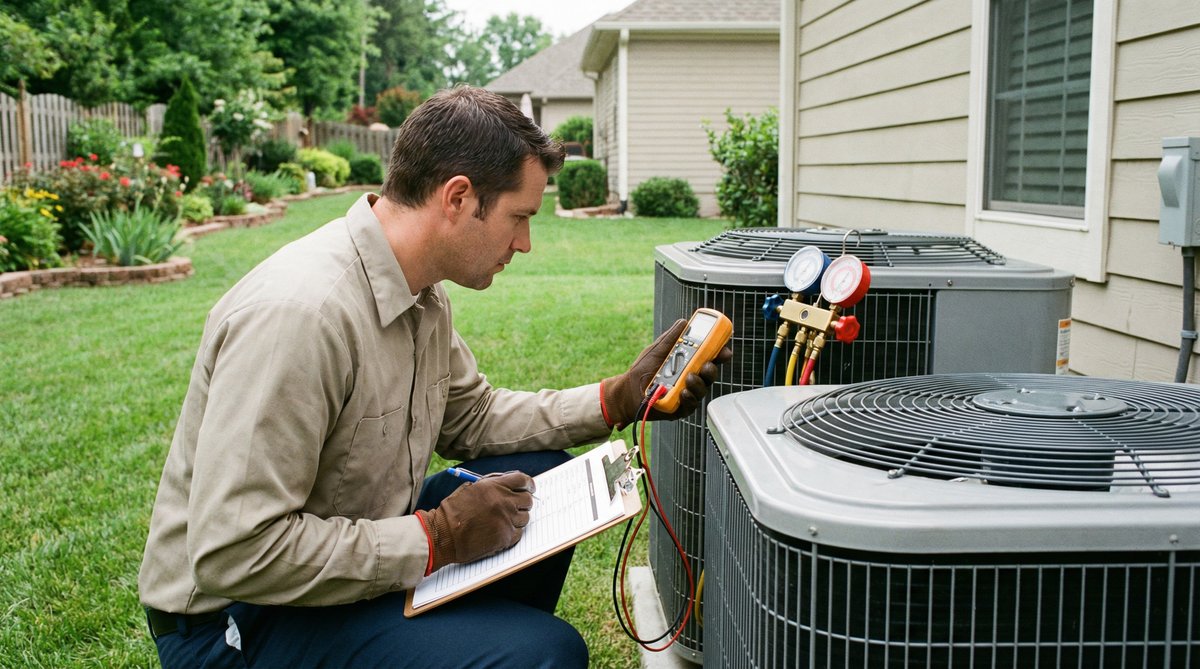
Alt text: An HVAC professional using a HVAC multimeter to check the high-voltage DC bus on an inverter-driven outdoor unit.
Frequently Asked Questions (FAQ)
Q: Is an inverter HVAC system worth the extra cost?
A: Yes, especially in climates with high usage. The energy savings typically pay for the price difference within 3-5 years, not including the added comfort of precise temperature and humidity control.
Q: Can I use a standard Nest or Ecobee thermostat with an inverter system?
A: It depends. Some systems require a proprietary communicating thermostat to unlock full variable-speed functionality. Others can use a standard thermostat but may revert to 2-stage operation. Always check the manufacturer's specifications.
Q: Do inverter systems break down more often?
A: Not necessarily, but they are more complex. While the compressor lasts longer, the electronic boards are more sensitive to power surges. Proper installation and surge protection are vital.
Q: How do I know if my AC is an inverter model?
A: Look for keywords like "Variable Speed," "Inverter-Driven," or high SEER2 ratings (18+). You can also check the model number on the outdoor unit's data plate.
Take Action: Upgrade Your Comfort Today
Whether you are looking for the ultimate in energy efficiency or a system that can handle the coldest winters, inverter technology is the answer. Don't settle for "on or off" comfort when you can have precision climate control.
Shop Inverter Mini Splits | Browse Variable Speed Heat Pumps
Need professional advice? Our team of HVAC experts is ready to help you find the perfect system for your home.
Contact HVAC Pro Sales:
* Email: support@hvacprosales.com
* Phone: 1-866-330-1709
References
- Lennox - Guide to HVAC Glossary: Inverter Technology
- Daikin - Benefits of Inverter Technology
- GREE Comfort - How Inverter Driven Compressors Work
- Danfoss - Variable Speed Technology for HVAC
- Mattioni Plumbing - How Do Inverter HVAC Systems Work?
- TCL Global - Difference Between Inverter and Non-Inverter AC