
High Head Pressure & Low Suction Diagnosis (2026 Troubleshooting Guide)
Published by HVACProSales Team on Feb 23rd 2026
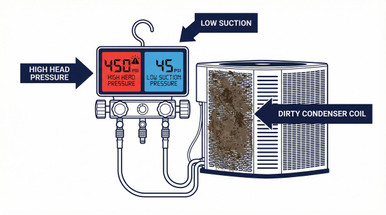
High Head Pressure & Low Suction Diagnosis (2026 Troubleshooting Guide)
Scope: This guide covers the combined symptom pattern of high head pressure with low suction pressure. If suction pressure is not low, use the dedicated high-head pressure diagnosis guide.
Quick Answer: What causes high head pressure and low suction pressure?
High head pressure is typically caused by poor airflow across the condenser coil (dirty coil, failing fan motor) or an overcharged system. Conversely, low suction pressure is most often caused by a low refrigerant charge, restricted airflow across the indoor evaporator coil (dirty filter, frozen coil), or a failing metering device like a restricted TXV. Accurately diagnosing these pressures requires measuring superheat and subcooling.
Table of Contents
- Understanding HVAC System Pressures
- Common Causes of High Head Pressure
- Common Causes of Low Suction Pressure
- Diagnostic Scenario: The Misdiagnosed TXV
- A Step-by-Step Diagnostic Process
- Expert Summary: Key Takeaways for Technicians
- Frequently Asked Questions (FAQ)
Understanding HVAC System Pressures
As an HVAC technician, your HVAC manifold gauge set are your window into the health of the refrigeration cycle. However, simply looking at the high-side (head pressure) and low-side (suction pressure) numbers isn't enough. You must understand how these pressures interact with temperature to accurately diagnose the root cause of a system failure.
Abnormal pressures—whether a skyrocketing head pressure that trips a high-limit switch, or a plummeting suction pressure that freezes an evaporator coil—are symptoms, not the disease itself. This guide provides a systematic approach to diagnosing both high head pressure and low suction pressure, helping you pinpoint the problem and prevent costly callbacks.
Common Causes of High Head Pressure
High head pressure occurs when the condenser is unable to reject heat efficiently, causing the pressure of the hot refrigerant gas to spike. If left unresolved, it can destroy the compressor valves or cause catastrophic compressor failure.
- Dirty Condenser Coil: The most common culprit. A blanket of dirt, pollen, or cottonwood prevents ambient air from absorbing heat from the coil.
- Failing Condenser Fan Motor: If the fan is spinning too slowly, running backward (due to a bad capacitor), or completely dead, heat rejection stops.
- System Overcharge: Too much refrigerant leaves no room in the condenser for the gas to condense into a liquid, driving pressures up.
- Non-Condensables in the System: Air or moisture trapped in the system (usually from poor vacuum practices during installation) will cause erratic and excessively high head pressures.
Accurate diagnosis starts with accurate tools. Upgrade to digital manifold gauges that automatically calculate superheat and subcooling in real-time, saving you time and eliminating math errors on the roof.
Common Causes of Low Suction Pressure
Suction pressure, or low-side pressure, is the pressure of the refrigerant as it leaves the evaporator and enters the compressor. A suction pressure lower than the manufacturer's specifications usually points to an absorption issue or a restriction.
- Low Refrigerant Charge: A leak in the system is the most frequent cause. Both high and low side pressures will typically be lower than normal, accompanied by high superheat and low subcooling.
- Restricted Indoor Airflow: If the blower motor fails, the air filter is severely clogged, or the return ducts are blocked, there is no heat load for the refrigerant to absorb. The pressure drops, and the coil eventually freezes.
- Metering Device Issues: A faulty Thermal Expansion Valve (TXV) that is stuck closed, or a restricted piston/orifice tube, starves the evaporator coil of refrigerant, plummeting the suction pressure.
- Liquid Line Restriction: A clogged filter drier or a kinked copper liquid line creates a pressure drop before the refrigerant even reaches the metering device.
Diagnostic Scenario: The Misdiagnosed TXV
A junior technician arrives at a no-cool call. He hooks up his analog gauges and sees a very low suction pressure of 45 PSI on an mini split refrigerant types system. Assuming the system is low on refrigerant, he immediately adds two pounds of R-410A. The suction pressure barely moves, but now the head pressure is dangerously high at 450 PSI.
What went wrong? The technician didn't check superheat and subcooling, nor did he check the indoor airflow. The actual problem was a completely plugged indoor air filter. By adding refrigerant to a system that couldn't absorb heat, he overcharged it, creating a high head pressure situation on top of the existing low suction issue.
The Lesson: Never add refrigerant based on pressure alone. Always verify airflow first, then use superheat and subcooling to diagnose the charge and the metering device.
Need to replace a restricted filter drier, a faulty TXV, or a blown HVAC capacitor replacement? We stock a massive inventory of OEM and universal HVAC components ready to ship.
A Step-by-Step Diagnostic Process
When faced with abnormal pressures, follow this strict, systematic process to avoid misdiagnosis:
- Verify Airflow First: Before connecting gauges, check the indoor air filter, ensure all supply/return vents are open, and verify the indoor blower is running at the correct speed. On the outside, ensure the condenser coil is clean and the fan is operating correctly.
- Connect Gauges and Temperature Probes: Attach your manifold gauges and place temperature clamps on the suction line (near the compressor) and the liquid line (near the service valve).
- Calculate Superheat and Subcooling:
* Low Suction + High Superheat + Low Subcooling = System is undercharged (find the leak).
* Low Suction + High Superheat + High Subcooling = Liquid line restriction or bad TXV.
* High Head + Low Superheat + High Subcooling = System is overcharged.
- Evaluate the Metering Device: If you suspect a TXV issue, try placing the TXV sensing bulb in warm water. If the suction pressure rises and superheat drops, the valve is mechanically working but may have lost its charge or was improperly insulated.
- Check for Temperature Drops: To find a liquid line restriction, measure the temperature of the copper pipe before and after the filter drier. A drop of more than 3 degrees Fahrenheit indicates a severe restriction inside the drier.
Recommended HVAC Parts & Tools
Expert Summary: Key Takeaways for Technicians
- Airflow is King: Restricted indoor airflow is a common cause of low suction pressure and should be checked before assuming the system is undercharged.
- Never Diagnose on Pressure Alone: Pressure readings are incomplete without corresponding temperature readings. Always calculate superheat and subcooling.
- High Head is Dangerous: High head pressure can cause immediate catastrophic failure. If head pressure is skyrocketing, shut the system down immediately and check the condenser coil and fan.
- Non-Condensables: If your pressures are bouncing erratically, you likely have air or moisture in the system. You will need to recover the charge, replace the filter drier, pull a deep vacuum (under 500 microns), and weigh in a virgin charge.
Frequently Asked Questions (FAQ)
Q: Can a bad HVAC capacitor cause high head pressure?
A: Yes. If the dual-run capacitor fails on the fan side, the condenser fan motor will stop spinning. Without the fan pulling air through the coil, the system cannot reject heat, causing the head pressure to spike rapidly until the compressor shuts off on thermal overload.
Q: Why is my suction pressure low but my head pressure is normal?
A: This scenario frequently points to a restriction in the system, such as a failing TXV or a clogged filter drier. The compressor is pumping fine (normal head), but the evaporator is being starved of refrigerant (low suction).
Q: How do I know if my TXV is bad or if I'm just low on freon?
A: Check your subcooling. If the system is low on refrigerant, subcooling will be very low (near zero). If the TXV is restricted, refrigerant will back up into the condenser, causing subcooling to be unusually high while suction pressure remains low.
Q: What happens if I overcharge an AC unit?
A: Overcharging floods the condenser coil with liquid refrigerant, leaving no room for the gas to condense. This causes high head pressure, high subcooling, decreased cooling capacity, and can eventually force liquid refrigerant into the compressor (slugging), destroying the valves.
Q: How do I fix a restricted liquid line?
A: You must recover the refrigerant from the system, cut out the restricted component (usually a clogged filter drier), braze in a new filter drier while flowing nitrogen, pull a deep vacuum, and recharge the system.