
![Why Is My AC Running But Not Cooling? Expert HVAC Troubleshooting Guide [7 Causes + Fixes 2026]](https://cdn11.bigcommerce.com/s-sjebkgblx5/images/stencil/190x250/https://files.manuscdn.com/user_upload_by_module/session_file/310519663234110120/yRxfVbAYOsZuRmks.jpg "Why Is My AC Running But Not Cooling? Expert HVAC Troubleshooting Guide [7 Causes + Fixes 2026]")
Why Is My AC Running But Not Cooling? Expert HVAC Troubleshooting Guide [7 Causes + Fixes 2026]
Published by HVACProSales Team on Mar 26th 2026
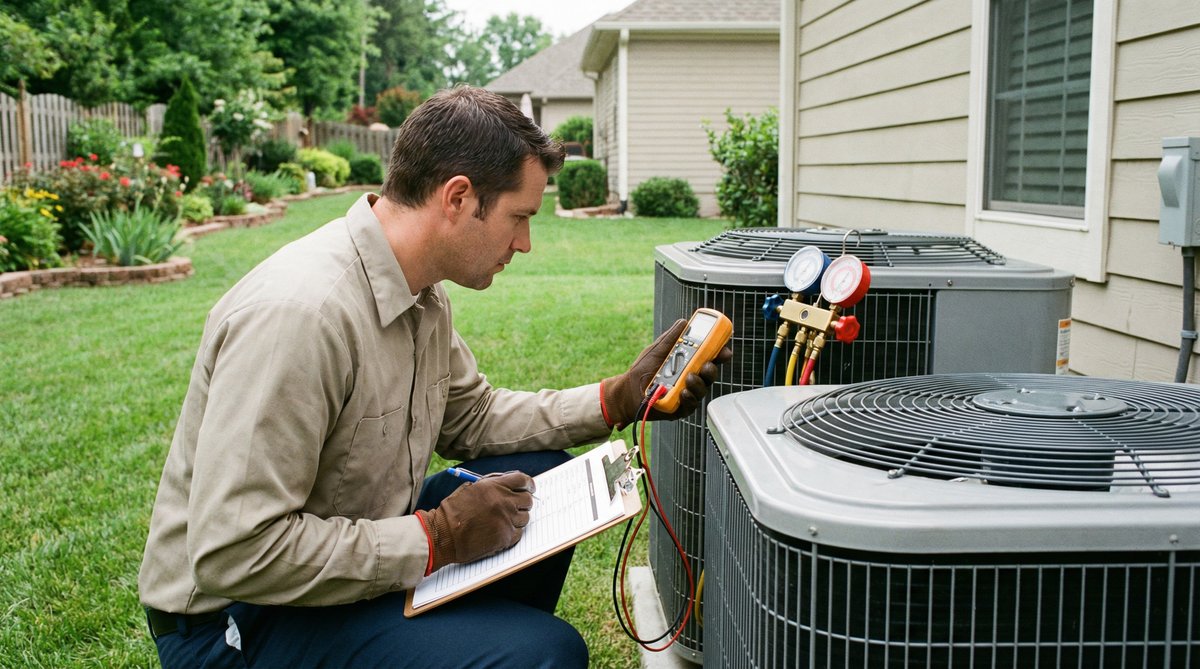
Why Is My AC Running But Not Cooling the House? Troubleshooting Guide
It is one of the most frustrating experiences for a homeowner: the thermostat is set to 72 degrees, the air conditioner is humming along outside, but the temperature inside continues to climb. When your AC is running but not cooling the house, it is often a sign of a system that is working against itself. This situation can lead to high energy bills, unnecessary wear on expensive components, and, of course, a very uncomfortable living environment.
🔍 Diagnosis Checklist
- Check the thermostat settings and battery first
- Inspect the air filter — replace if dirty or clogged
- Check the circuit breaker and reset if tripped
- Inspect the capacitor and contactor for visible damage
- Verify refrigerant pressure is within spec using manifold gauges
- Call a licensed technician if the fault is not identified
As an HVAC professional, I have seen this scenario hundreds of times. While some causes are as simple as a flick of a switch or a $20 filter, others point to more serious mechanical failures that require expert intervention. Understanding why your system is failing to provide relief is the first step toward restoring comfort to your home.
Direct Answer (AEO): If your AC is running but not cooling, the most common causes include a clogged air filter, incorrect thermostat settings, dirty condenser coils, or a HVAC refrigerant leak check. Before calling a technician, ensure your thermostat is set to "Cool" and "Auto," replace your air filter, and check your outdoor unit for debris.
Immediate Troubleshooting: The "Check This First" List
Before diving into complex mechanical issues, start with these basic checks. Many "broken" air conditioners are simply victims of incorrect settings or minor maintenance oversights.
1. Verify Your Thermostat Settings
It sounds simple, but many service calls end with a technician merely adjusting the thermostat. Ensure the system is set to "Cool" and the temperature is lower than the current room temperature. Most importantly, check the fan setting. If the fan is set to "On" instead of "Auto," the blower will run continuously even when the AC isn't actually cooling, which can make it feel like the system is failing when it's just circulating room-temperature air.
2. Inspect the Air Filter
A clogged air filter is the single most common cause of cooling issues. When the filter is packed with dust and pet dander, it restricts the airflow your system needs to function. Without enough air passing over the evaporator coils, the system cannot remove heat from your home effectively. In extreme cases, a dirty filter can even cause the indoor coils to freeze over.
3. Check the Circuit Breaker
Air conditioning systems use two main components: the indoor air handler and the outdoor condenser. Sometimes, the breaker for the outdoor unit trips while the indoor unit keeps running. If you hear the indoor fan blowing but don't hear the hum of the outdoor compressor, check your electrical panel for a tripped breaker.
Alt text: A professional HVAC technician inspecting a digital thermostat for correct settings.

Problem -> Cause -> Solution: The Deep Dive
When the basics don't solve the problem, we need to look at the internal components. The table below summarizes the primary technical reasons an AC might run without cooling.
| Problem Area | Primary Cause | Solution |
|---|---|---|
| Airflow Restriction | Clogged filter or blocked vents | Replace filter; ensure all supply and return vents are open. |
| Heat Dissipation | Dirty outdoor condenser coils | Gently clean the outdoor unit with a garden hose. |
| Refrigeration Cycle | Low refrigerant (Freon) levels | Professional leak repair and refrigerant recharge. |
| Thermal Exchange | Frozen evaporator coils | Turn off the AC, run the fan to thaw, and address airflow issues. |
| Mechanical Failure | Faulty compressor or fan motor | Requires professional diagnostic and component replacement. |
The Role of the Outdoor Condenser
The outdoor unit’s job is to release the heat collected from inside your home. If the aluminum fins on the condenser are covered in dirt, grass clippings, or dryer lint, the heat has nowhere to go. This causes the compressor to overheat and lose efficiency. You can often fix this yourself by gently spraying the unit with a garden hose (avoid high-pressure washers, which can damage the delicate fins).
The "Ice" Paradox: Why Your AC Freezes in Summer
It seems counterintuitive, but an AC unit can actually freeze solid during a heatwave. This happens when the evaporator coil (the part inside your house) gets too cold. Two things usually cause this: restricted airflow (not enough warm air hitting the coil) or low refrigerant (the coil gets too cold because of a pressure drop). If you see ice on the copper lines or the indoor unit, turn the system off immediately. Running a frozen AC can lead to a "slugged" compressor, which is a fatal and expensive failure.
Professional Insights: Hidden Culprits
Beyond the obvious mechanical parts, several other factors can prevent your home from reaching the desired temperature.
Ductwork Leaks and Disconnections
You could have the most efficient AC in the world, but if your ductwork is leaking, that cold air is being pumped into your attic or crawlspace instead of your living room. Over time, duct tape can fail, or rodents can chew through flexible ducting. A professional duct inspection can reveal if you are losing 20-30% of your cooling capacity before it ever reaches your vents.
System Sizing and "Short Cycling"
If your AC is running constantly but the house never feels cool, the system might be undersized for your home's square footage or heat load. Conversely, an oversized unit will "short cycle," turning on and off so quickly that it never manages to dehumidify the air, leaving your home feeling clammy and warm.
Pro Tip: "If your system is more than 12-15 years old, it may simply be reaching the end of its mechanical life. Older units use R-22 refrigerant, which is no longer produced and is extremely expensive to service. In these cases, a modern, high-efficiency replacement is often the most cost-effective long-term solution." — HVAC Pro Sales Expert Team
Real-World Use Case: The "Lukewarm" Bedroom
Consider a homeowner, Sarah, who noticed her bedroom was 80 degrees while the AC was set to 70. The system was running, but the air coming from the vents felt lukewarm. Upon inspection, the technician found that Sarah had placed a large dresser directly in front of the return air vent. This starved the system of air, causing the coils to freeze. Once the dresser was moved and the system thawed, the AC returned to normal operation. This highlights how even simple furniture placement can impact your HVAC performance.
Alt text: An outdoor air conditioning condenser unit partially blocked by overgrown bushes and leaves.

Frequently Asked Questions (FAQ)
Q: How often should I change my AC air filter?
A: For standard 1-inch filters, you should check them every 30 days and replace them at least every 90 days. If you have pets or allergies, monthly replacement is recommended.
Q: Can I "top off" my own AC refrigerant?
A: No. AC systems are closed loops; they do not "consume" refrigerant. If it is low, there is a leak that must be found and repaired by a licensed EPA-certified technician. Handling refrigerant without a license is illegal and dangerous.
Q: Why is my AC unit covered in ice?
A: Ice typically indicates a lack of airflow (dirty filter/blocked vents) or a refrigerant leak. Turn the system off and set the fan to "On" to melt the ice before calling for service.
Q: Is it okay to run my AC if it's not cooling?
A: No. If the system is running but not cooling, it is under extreme stress. Continuing to run it can cause the compressor to overheat or fail, turning a simple repair into a multi-thousand-dollar replacement.
Need Professional HVAC Parts or Support?
If you've identified the problem and need high-quality replacement parts, or if you're ready to upgrade to a more efficient system, we are here to help.
Call Us Today: 1-866-330-1709
Email: support@hvacprosales.com
Schema Markup
Recommended HVAC Parts & Tools
⚡ Quick Answer
The most common cause is a failed component such as a capacitor, contactor, or refrigerant leak. Start by checking the capacitor with a multimeter, inspect the contactor for pitting, and verify refrigerant charge. In most cases, a DIY repair is possible with the right tools.
Key Takeaways
- Regular preventive maintenance reduces emergency repair costs by up to 40%.
- Always disconnect power before servicing any HVAC component.
- Document all service work including refrigerant amounts and part numbers.
- Use OEM or OEM-equivalent parts for best reliability and compatibility.
- When in doubt, consult a licensed HVAC technician.
Common Mistakes to Avoid
- Skipping the diagnostic step: Replacing parts without proper diagnosis wastes money and time.
- Ignoring electrical safety: Always verify power is off with a non-contact voltage tester before touching any wiring.
- Using non-OEM parts: Cheap aftermarket parts often fail prematurely and may void equipment warranties.
- Not documenting repairs: Failing to log refrigerant amounts and part numbers creates compliance and warranty issues.
🛒 Shop HVAC Parts & Tools — Fast Shipping
-
Shop All HVAC Parts →
Capacitors, contactors, motors, boards & more — fast shipping -
Shop Professional HVAC Tools →
Everything a technician needs — trusted by HVAC pros -
Shop Mini Split Parts →
OEM-quality parts for all major mini split brands
Questions? Call 1-866-330-1709 or email support@hvacprosales.com