
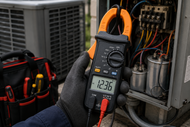
Best Clamp Meters for HVAC Technicians (2026 Reviews)
Published by HVACProSales Editorial Team on Jun 23rd 2026
For professional HVAC technicians and serious DIY diagnostic work, a high-quality clamp meter is the most important tool in the diagnostic bag. Measuring electrical parameters accurately is vital to diagnosing system faults safely and efficiently.
Why Standard Multimeters Fall Short in HVAC
Standard electrical multimeters lack the specialized functions required for HVAC diagnostics. For example, testing a furnace flame sensor requires measuring extremely low direct current (0.5 to 10 microamps DC), which standard meters cannot resolve. Additionally, measuring compressor startup current requires an "Inrush" mode that captures the peak current spike over a 100-millisecond window — standard average-responding meters are far too slow to capture this critical metric.
Comparison of Professional HVAC Clamp Meters
| Meter Model | Microamps (µA DC) | Capacitance Range | Inrush Current | Safety Rating |
|---|---|---|---|---|
| Fluke 902 FC | Yes (0.1 - 200 µA) | Up to 1,000 µF | Yes | CAT III 600V / CAT IV 300V |
| Fieldpiece SC440 | Yes (0.1 - 400 µA) | Up to 4,000 µF | Yes | CAT III 600V |
| Klein Tools CL440 | Yes (0.1 - 2000 µA) | Up to 6,000 µF | No | CAT III 600V |
Crucial Features for HVAC Troubleshooting
When selecting a diagnostic clamp meter, ensure it includes these four non-negotiable features:
- True RMS: Essential for accurate AC voltage and current readings on modern inverter-driven compressors and variable-speed ECM motors, which generate non-sinusoidal electrical noise.
- LoZ (Low Input Impedance): Eliminates ghost voltages caused by capacitive coupling in parallel wires, preventing false voltage readings.
- Non-Contact Voltage (NCV): Provides a quick visual and audible safety check to verify a circuit is dead before opening an electrical panel.
- Temperature (K-Type Thermocouple): Allows direct measurement of suction line and liquid line temperatures to calculate superheat and subcooling.
Commercial Tool Sourcing & Professional Gear
Equipping your service team with high-quality, reliable diagnostic tools is essential for maintaining safety, diagnostic accuracy, and jobsite efficiency. We stock a complete line of professional HVAC clamp meters, multimeters, and specialized testing gear. Browse our tools category or contact our team for assistance in outfitting your service fleet.
Upgrading Your Diagnostic Toolkit?
Explore our selection of professional Fluke and Fieldpiece clamp meters, digital manifolds, and specialized HVAC tools.
Speak with an HVAC Specialist Request a QuoteFrequently Asked Questions
Why do I need microamps on an HVAC meter?
Furnace flame sensors operate on a flame rectification circuit. The flame itself acts as a conductor, converting AC voltage from the control board into a tiny DC microamp current. If the meter cannot measure microamps, you cannot diagnose whether a furnace shutdown is caused by a dirty flame sensor or a failed control board.
What is the difference between CAT III and CAT IV safety ratings?
CAT III covers three-phase distribution, including large commercial lighting and heavy-duty HVAC equipment. CAT IV covers the origin of the installation, such as utility service entrances and electricity meters. For residential and light commercial HVAC work, a CAT III 600V rating is the minimum safety standard.
What does True RMS mean?
True RMS (Root Mean Square) meters use complex mathematical algorithms to calculate the heating value of an AC waveform. Average-responding meters assume a perfect sine wave and will read up to 10% low or 30% high when measuring non-sinusoidal waveforms generated by modern variable-frequency drives (VFDs) and inverter compressors.