
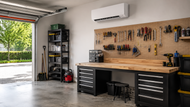
Best Mini Split for Garages & Workshops (2026 Buyer Guide)
Published by HVACProSales Editorial Team on Jun 11th 2026
Garages and workshops are notoriously difficult spaces to heat and cool. Traditional ducted systems are rarely feasible due to lack of ductwork, while window units are noisy, inefficient, and insecure. A high-quality garage mini split is the ideal solution for year-round comfort.
Why Garages Require Unique HVAC Planning
Garages differ significantly from standard living spaces. They typically lack insulation in the walls and garage doors, feature high concrete thermal mass, and have high infiltration rates from frequent door openings. Consequently, a garage requires higher BTU capacity per square foot than a bedroom of identical size. Additionally, woodworking dust or automotive fumes require robust, washable filtration systems.
Sizing Chart for Garage Mini Splits
| Garage Size | Square Footage | Recommended BTU (Insulated) | Recommended BTU (Uninsulated) |
|---|---|---|---|
| 1-Car Garage | 200 - 300 sq ft | 9,000 BTU | 12,000 BTU |
| 2-Car Garage | 400 - 500 sq ft | 12,000 BTU | 18,000 BTU |
| 3-Car Garage | 600 - 800 sq ft | 18,000 BTU | 24,000 BTU |
| Large Workshop | 900 - 1,200 sq ft | 24,000 BTU | 36,000 BTU |
The DIY Advantage: MRCOOL Easy Connection
For workshops and garages, the MRCOOL DIY series is highly popular. It features pre-charged line sets (Quick Connect) that require no specialized vacuum pumps or manifold gauges to install. A homeowner with basic hand tools can mount the indoor handler, run the lines through a 3-inch wall hole, connect them to the outdoor condenser, and release the refrigerant safely, saving thousands in professional installation fees.
Crucial Maintenance for Workshop Mini Splits
If you run a woodworking shop, metalworking shop, or craft studio, your mini split will process high volumes of airborne particulate. To prevent motor failure and maintain heat transfer, you must clean the return air filters every two weeks. Additionally, installing a secondary external filter media over the return air grille can protect the delicate indoor coil from fine sawdust accumulation.
Sourcing Your Garage Mini Split
Ready to transform your garage into a comfortable, year-round workspace? We stock a full range of single-zone mini splits and MRCOOL DIY systems designed for rapid, high-efficiency installation. Browse our mini split category or contact our team for assistance in sizing your space.
Ready to Heat and Cool Your Garage?
Explore our selection of MRCOOL DIY systems and professional single-zone mini splits optimized for workshops and garages.
Visit Our Contact Page Request a QuoteFrequently Asked Questions
Should I insulate my garage before installing a mini split?
While not strictly mandatory, insulating your garage walls and doors will significantly reduce your heating and cooling load, allowing you to use a smaller, less expensive mini split and save on energy bills.
Does a garage mini split require 220V power?
9,000 and 12,000 BTU systems are often available in 115V configurations, allowing them to run on standard household circuits. 18,000 BTU and larger systems almost always require a dedicated 208/230V circuit.
Can woodworking dust ruin my mini split?
Fine sawdust can clog the indoor coil and drain pan, leading to water leaks and reduced airflow. If you generate high volumes of dust, turn off the mini split during heavy sanding, or use a high-efficiency dust collection system alongside washable filters.